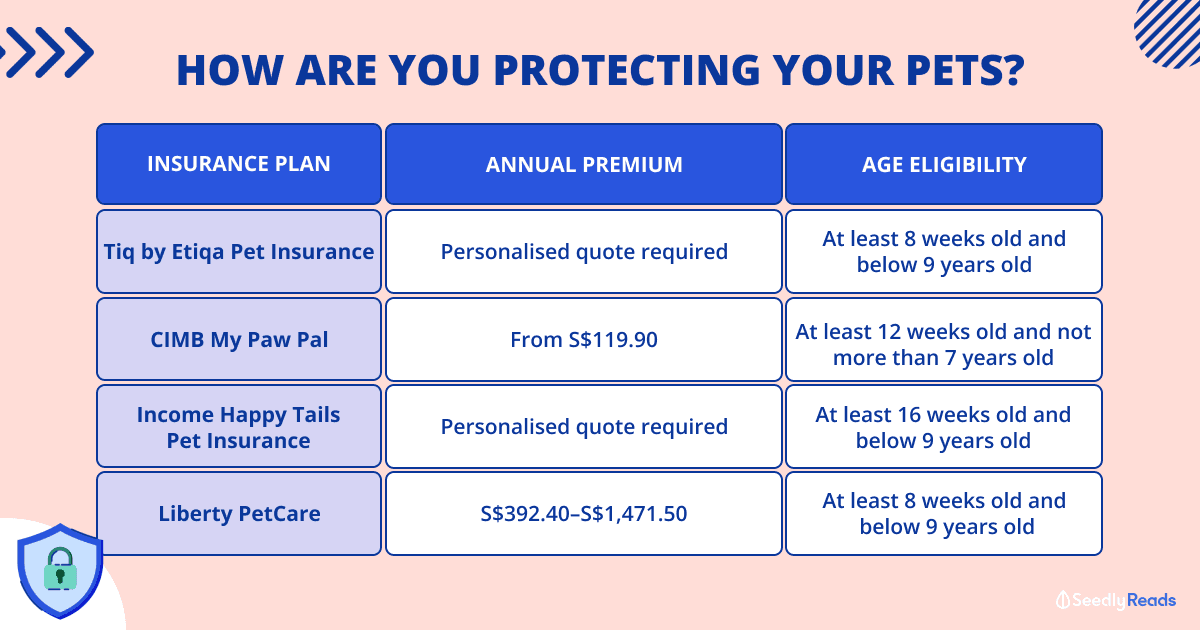

Keeping a pet in Singapore can be expensive. Besides food, grooming and licensing costs, pet owners may also face significant veterinary bills when their dog or cat becomes ill or gets injured.
Pet insurance can help reduce the financial impact of certain unexpected veterinary expenses. Depending on the policy, coverage may include accidental injuries, illnesses, surgery, chemotherapy, final expenses and third-party liability.
However, not every pet insurance policy provides the same benefits. Some plans focus mainly on accidental injuries, while others offer broader medical coverage for illnesses and surgery. It is therefore important to compare the coverage limits, co-insurance, deductibles, waiting periods and exclusions before purchasing a policy.
Here is our updated pet insurance comparison guide for dog and cat owners in Singapore.
Do note that the plans compared below cover dogs and cats. Pets generally need to be microchipped and comply with the applicable licensing and registration requirements in Singapore.
TL;DR: Pet Insurance for Dogs and Cats in Singapore
| Pet insurance plan | Best suited for | Key coverage highlights | Entry age |
| Tiq by Etiqa Pet Insurance | Owners seeking high surgical coverage and coverage for selected hereditary and congenital conditions | Up to S$15,000 for surgical illness, S$3,500 for non-surgical illness, S$3,500 for accidental injury, S$500,000 third-party liability and S$500 funeral expenses | At least eight weeks old and below nine years old |
| CIMB My Paw Pal | Owners seeking affordable accident-focused coverage | S$1,500 accidental-death benefit, up to S$1,500 annual accident medical expenses and S$250,000 third-party liability | At least 12 weeks old and not more than seven years old |
| Income Happy Tails | Owners seeking high annual medical limits, chemotherapy coverage and cashless scheduled surgery support | Up to S$27,000 maximum annual coverage, including S$22,000 clinical and surgical coverage and S$5,000 chemotherapy coverage | At least 16 weeks old and below nine years old |
| Liberty PetCare | Owners who want multiple plan tiers, freedom to choose a veterinarian and wellness benefits under selected plans | Up to S$18,000 surgical treatment, S$5,000 non-surgical treatment, S$7,000 accidental injury and S$500,000 third-party liability | At least eight weeks old and below nine years old |
Annual premiums may depend on your pet’s species, breed, age and selected level of coverage. Obtain a personalised quotation from each insurer before comparing prices.
Pet Insurance for Dogs in Singapore
When comparing dog insurance plans in Singapore, check whether the policy covers both accidental injuries and illnesses.
You should also review whether the policy includes theft, third-party liability and hereditary or congenital conditions. These benefits are not automatically included in every plan.
Dogs generally need to be microchipped and licensed with the Animal and Veterinary Service where required.
| Plan | Key dog-insurance benefits | Important considerations |
| Tiq by Etiqa Pet Insurance | Surgical and non-surgical illness treatment, accidental injury, funeral expenses, third-party liability and selected hereditary or congenital conditions | A completed clinical examination form must be submitted within the required period to receive the complimentary hereditary and congenital coverage. A 12-month waiting period applies |
| CIMB My Paw Pal | Accidental death, accident medical expenses, accident-related cremation or burial expenses and third-party liability | Illness coverage requires Optional Cover B, while theft coverage requires Optional Cover A |
| Income Happy Tails | Clinical and surgical treatment, chemotherapy, final expenses and third-party legal liability | A clinical examination is required before or within 30 days of the policy start date |
| Liberty PetCare | Accidental injuries, illness-related surgical and non-surgical veterinary expenses, theft, third-party liability and wellness benefits under selected plans | Non-surgical illness treatment is subject to higher co-insurance. Hereditary and congenital conditions are excluded |
Pet Insurance for Cats in Singapore
Cat insurance plans generally provide many of the same medical benefits as dog-insurance policies. However, theft coverage may not be available for cats.
Singapore’s Cat Management Framework was introduced on 1 September 2024. Cat owners should ensure that their pets are microchipped and licensed or registered in accordance with the prevailing requirements.
| Plan | Key cat-insurance benefits | Important considerations |
| Tiq by Etiqa Pet Insurance | Illness treatment, accidental injury, funeral expenses, third-party liability and selected hereditary or congenital conditions | The required clinical examination form must be submitted for hereditary and congenital coverage. A 12-month waiting period applies |
| CIMB My Paw Pal | Accidental death, accident medical expenses, accident-related final expenses and third-party liability | Optional theft coverage is not available for cats. Illness coverage requires Optional Cover B |
| Income Happy Tails | Clinical and surgical treatment, chemotherapy, final expenses and third-party legal liability | The cat must undergo a clinical examination before or within 30 days of the policy start date |
| Liberty PetCare | Surgical and non-surgical illness treatment, accidental injury, third-party liability and wellness benefits under selected plans | Theft coverage is not available for cats. Hereditary and congenital conditions are excluded |
What Does Pet Insurance Cover?
Coverage varies between insurers and plans. Always review the benefit schedule and policy wording instead of assuming that every veterinary bill will be reimbursed.
Depending on the policy, pet insurance may cover:
- Veterinary treatment following an accidental injury
- Surgical treatment caused by an illness
- Non-surgical or outpatient treatment
- Diagnostic tests
- Prescribed medication
- Hospital room and board
- Pre- and post-surgical treatment
- Chemotherapy
- Accidental death
- Euthanasia, cremation or burial expenses
- Third-party legal liability
- Theft of an insured dog
- Selected hereditary or congenital conditions
- Preventive or wellness care under selected plans
However, most pet insurance policies exclude pre-existing conditions. Waiting periods, claim limits, co-insurance and deductibles may also apply.
Certain benefits may only apply under higher-tier plans or optional add-ons. For example, CIMB My Paw Pal’s basic plan focuses primarily on accidental injuries, while illness coverage must be purchased separately.
Pet Insurance Medical Treatment Coverage
Medical coverage is one of the most important areas to compare when choosing a pet insurance plan in Singapore.
Tiq provides separate limits for surgical illness, non-surgical illness and accidental injuries. Income Happy Tails combines clinical and surgical coverage with a separate chemotherapy benefit.
Liberty also separates surgical and non-surgical veterinary expenses. Meanwhile, CIMB My Paw Pal’s basic plan focuses on accidental injuries unless Optional Cover B is purchased.
When comparing plans, check whether the policy covers:
- Non-surgical consultations and treatment
- Diagnostic tests
- Prescription medication
- Surgery and operating-theatre charges
- Hospitalisation
- Rehabilitation and post-surgical care
- Cancer treatment and chemotherapy
- Selected hereditary or congenital conditions
You should also check whether each benefit limit applies per incident, per accident, per policy year or over your pet’s lifetime.
A plan may advertise a high overall annual limit while imposing lower limits on individual treatment categories. Always review the detailed benefit schedule.
Pet Insurance Terms in Singapore
Understanding common insurance terms can make it easier to compare pet insurance plans.
- Co-insurance: The percentage of an eligible claim that the policyholder must pay.
- Deductible or excess: A fixed amount that the policyholder must bear as part of an eligible claim.
- Annual limit: The maximum amount the insurer will pay during a policy year.
- Per-incident limit: The maximum amount payable for one accident, illness or treatment episode.
- Waiting period: A period after the policy begins during which certain claims are not covered.
- Pre-existing condition: A condition, illness, injury or symptom that existed before the insurance coverage began, based on the insurer’s policy definition.
- No-claim discount: A renewal discount that may apply after one or more claim-free years.
- Entry age: The age range during which a pet may be enrolled in a new policy.
- Renewal age: The maximum age until which the policy may continue, subject to the insurer’s renewal terms.
Co-insurance and Deductible Example
Suppose your pet has an eligible veterinary bill of S$500. The policy has a S$100 deductible and 20% co-insurance.
The insurer may first subtract the deductible before applying co-insurance to the remaining amount. However, the exact calculation method can differ between insurers.
You should therefore refer to the insurer’s policy wording or worked claim example instead of relying on a generic calculation.
The policy may also impose separate deductibles or co-insurance percentages for different benefits. For example, accidental-injury treatment may be calculated differently from illness-related treatment.
Which Insurance Should You Get for Your Pet?
The best pet insurance plan depends on your pet’s needs, medical history and your budget.
Before purchasing a policy, consider the following factors.
1. Your Pet’s Age
Entry-age requirements differ between insurers. It may become harder to purchase a new policy as your pet gets older.
Enrolling a pet earlier may also result in lower co-insurance under certain plans. However, you should still check the insurer’s renewal terms and whether the applicable co-insurance rate can change.
2. Breed-Related Health Risks
Certain breeds may be more susceptible to hereditary or congenital conditions such as:
- Hip and elbow dysplasia
- Luxating patella
- Intervertebral disc disease
- Glaucoma
- Cherry eye
Do not assume that hereditary conditions are automatically covered. Tiq and Income cover selected conditions subject to their respective requirements, while Liberty lists hereditary and congenital conditions among its major exclusions.
3. Medical History
Pre-existing conditions are generally excluded.
Read the insurer’s definition carefully and provide complete and accurate information when applying. Failing to disclose relevant medical information may affect future claims.
4. Accident Exposure
Accident and third-party liability coverage may be especially important if your pet regularly spends time outdoors or comes into contact with members of the public and other animals.
Third-party liability may help cover eligible legal liability if your pet injures someone or damages their property, subject to the policy terms.
5. Surgical and Non-Surgical Limits
A policy with a high surgical limit may still offer relatively limited outpatient or non-surgical coverage.
Compare both treatment categories, especially if your pet may require frequent consultations, diagnostic tests or medication without undergoing surgery.
6. Co-insurance and Deductibles
A lower premium does not always result in lower overall expenses.
A policy with high co-insurance may leave you paying a significant share of every eligible veterinary bill. You should calculate how much you may need to pay under different claim scenarios.
7. Waiting Periods
Some benefits do not begin immediately.
For example, Tiq’s complimentary coverage for selected hereditary and congenital conditions is subject to a 12-month waiting period and other requirements.
Check the policy wording for waiting periods covering illnesses, hereditary conditions and other benefits.
8. Renewability
Check how long your pet can remain covered after successful enrolment.
You should also confirm whether renewal is guaranteed or subject to the insurer’s approval, and whether the insurer may change its premiums, benefits or policy terms at renewal.
9. Premium Affordability
Choose a premium that you can continue paying over the long term.
Cancelling a policy and purchasing a new one later may be difficult because your pet may have exceeded the entry-age limit or developed a medical condition that would be treated as pre-existing.
Tiq by Etiqa Pet Insurance
Tiq by Etiqa Pet Insurance provides coverage for illnesses, accidental injuries, funeral expenses and third-party liability.
Its highest-tier plan currently provides:
| Benefit | Maximum coverage |
| Surgical illness | Up to S$15,000 |
| Non-surgical illness | Up to S$3,500 |
| Accidental injury | Up to S$3,500 |
| Funeral expenses | Up to S$500 |
| Third-party liability | Up to S$500,000 |
A S$200 deductible applies to illness claims in Tiq’s current benefit structure, while accidental-injury claims are subject to a S$50 deductible.
Co-insurance also applies. The applicable percentage may depend on the pet’s age at enrolment and the selected coverage. Owners should check the latest quotation and policy wording for the full co-insurance schedule.
Tiq provides complimentary coverage for six specified congenital and hereditary conditions:
- Hip and elbow dysplasia
- Luxating patella
- Glaucoma
- Cherry eye
- Intervertebral disc disease
- Conditions requiring femoral head and neck excision
To qualify for this coverage, the pet must satisfy the policy requirements and a completed clinical examination form must be submitted within 30 days of purchasing the policy.
A 12-month waiting period applies to the specified congenital and hereditary coverage. Pre-existing conditions remain excluded.
Tiq may therefore suit owners who prioritise high surgical limits and coverage for selected hereditary or congenital conditions.
Entry age: At least eight weeks old and below nine years old.
Current premium: Obtain a personalised quotation from Tiq.
CIMB My Paw Pal
CIMB My Paw Pal provides a relatively affordable basic policy focused mainly on accidental injuries.
The basic plan currently costs S$119.90 a year, inclusive of GST, and includes:
| Benefit | Maximum coverage |
| Accidental death | S$1,500 |
| Medical expenses caused by an accident | Up to S$1,500 per year |
| Cremation or burial expenses caused by an accident | Up to S$300 |
| Third-party liability | Up to S$250,000 |
Pet owners may purchase the following optional covers:
| Optional cover | Additional annual premium | Coverage |
| Option A | S$44.69 | Up to S$1,500 if an insured dog is lost due to theft |
| Option B | S$403.30 | Medical expenses caused by illness and illness-related cremation or burial expenses, subject to the applicable limits |
Option A is only available for dogs and does not cover cats.
Under Option B, the medical-expense limit is up to S$1,500 per year inclusive of the basic plan’s medical-expense limit. It should not be interpreted as an additional S$1,500 on top of the basic-plan limit.
The cremation or burial benefit under Option B is also subject to the applicable combined policy limits.
A minimum medical claim amount of S$100 applies.
CIMB My Paw Pal may suit owners seeking basic accident protection at a comparatively accessible premium. However, once Optional Cover B is added, owners should compare the total premium and medical limits against more comprehensive policies.
Entry age: At least 12 weeks old and not more than seven years old.
Current premium: S$119.90 a year for the basic plan, inclusive of GST, excluding optional covers.
Income Happy Tails Pet Insurance
Income Happy Tails currently offers three plans:
- Furry
- Furbulous
- Furrific
The coverage limits are:
| Benefit | Furry | Furbulous | Furrific |
| Maximum annual coverage | S$8,500 | S$15,000 | S$27,000 |
| Clinical and surgical benefit | S$6,000 | S$12,000 | S$22,000 |
| Chemotherapy benefit | S$2,500 | S$3,000 | S$5,000 |
| Final expenses benefit | S$750 | S$1,500 | S$2,500 |
| Third-party legal liability | S$250,000 | S$500,000 | S$1 million |
| Medical expenses caused by accidental injury | Not available | Not available | S$2,500 per accident |
A S$250 deductible per incident applies to the relevant medical benefits.
Co-insurance depends on the pet’s age at enrolment:
- 20% for dogs or cats enrolled before age four
- 30% for dogs or cats enrolled before age seven
- 40% for dogs or cats enrolled before age nine
If a pet is enrolled before age four, the 20% co-insurance rate may continue for its lifetime as long as continuous coverage is maintained, subject to the policy terms.
Income Happy Tails also covers six specified hereditary and congenital conditions:
- Hip and elbow dysplasia
- Luxating patella
- Glaucoma
- Cherry eye
- Intervertebral disc disease
- Conditions requiring femoral head and neck excision
The dog or cat must undergo a clinical examination before or within 30 days of the policy start date.
Income also offers a Letter of Guarantee and cashless service for eligible scheduled surgeries at Beecroft Animal Hospital, subject to approval and the applicable conditions.
Income Happy Tails may suit owners seeking high annual medical limits, chemotherapy coverage and additional convenience when arranging eligible scheduled surgeries.
Entry age: At least 16 weeks old and below nine years old.
Current premium: Obtain a personalised quotation from Income Insurance.
Liberty PetCare
Liberty PetCare currently offers five plans:
- Adogable
- Ameowing
- Furtastic
- Ultipaw
- Pawsh
Depending on the plan selected, benefits may include:
| Benefit | Maximum coverage |
| Accidental death | Up to S$8,000 |
| Accidental injury | Up to S$7,000 |
| Loss of an insured dog due to theft | Up to S$3,000 |
| Non-surgical veterinary expenses | Up to S$5,000 |
| Surgical veterinary expenses | Up to S$18,000 |
| Third-party liability | Up to S$500,000 |
| Final expenses following accidental death | Up to S$600 |
| Wellness care | Up to S$200 |
Liberty allows policyholders to visit any veterinarian in Singapore, subject to the policy’s terms and eligibility requirements.
No prior medical examination is required when applying. However, pre-existing conditions and other listed exclusions remain uncovered.
For eligible surgical illness treatment, the policyholder generally bears:
- 20% co-insurance if the pet was enrolled before age five
- 30% co-insurance if the pet was enrolled before age nine
This means Liberty may reimburse up to 80% of eligible surgical expenses for pets enrolled before age five, subject to the applicable policy limits and exclusions.
However, this reimbursement level does not apply uniformly to every veterinary bill.
Non-surgical illness treatment is subject to 50% co-insurance. Accidental-injury claims are subject to the applicable deductible stated in the policy.
Hereditary and congenital conditions are among Liberty PetCare’s major exclusions.
Selected higher-tier plans also include wellness care for eligible services such as:
- Veterinary examinations
- Vaccinations
- Teeth cleaning
- Sterilisation
The final-expenses benefit applies following the insured pet’s accidental death. It should not be interpreted as general coverage for final expenses caused by illness.
Liberty PetCare may suit owners who want several plan tiers, the flexibility to choose their veterinarian and wellness benefits under selected plans.
Entry age: At least eight weeks old and below nine years old.
Current premium: Obtain a personalised quotation from Liberty.
Pet Insurance Comparison: Key Differences
The following table summarises several important differences between the four policies.
| Feature | Tiq by Etiqa | CIMB My Paw Pal | Income Happy Tails | Liberty PetCare |
| Accident coverage | Yes | Yes | Only under the applicable plan and benefit | Yes |
| Illness coverage | Yes | Requires Optional Cover B | Yes | Yes |
| Surgical illness coverage | Up to S$15,000 | Subject to Option B’s combined limit | Up to S$22,000 | Up to S$18,000 |
| Chemotherapy coverage | Subject to policy terms | Not separately stated | Up to S$5,000 | Subject to the relevant veterinary-expense benefit and policy terms |
| Selected hereditary or congenital conditions | Yes, subject to requirements and a 12-month waiting period | Check policy exclusions | Yes, for six specified conditions | Excluded |
| Third-party liability | Up to S$500,000 | Up to S$250,000 | Up to S$1 million | Up to S$500,000 |
| Theft coverage | Check selected plan | Optional for dogs only | Check policy wording | Available for dogs under selected plans |
| Wellness coverage | Not a core benefit | No | No | Up to S$200 under selected plans |
| Cashless scheduled surgery service | No stated equivalent | No stated equivalent | Available for eligible scheduled surgeries at Beecroft Animal Hospital | No stated equivalent |
Coverage remains subject to each insurer’s terms, limits, exclusions and claim requirements.
Is Pet Insurance Worth It in Singapore?
Pet insurance may be worth considering if an unexpected veterinary bill would place significant pressure on your finances.
It may be particularly useful for owners who:
- Want financial protection against large surgical bills
- Own a breed that may be susceptible to certain medical conditions
- Have an active pet with greater exposure to accidental injuries
- Want third-party liability protection
- Prefer to pay a regular premium rather than bear the full cost of an eligible emergency at once
However, pet insurance does not cover every veterinary expense.
You may still need to pay:
- Deductibles
- Co-insurance
- Expenses exceeding the policy limit
- Treatment for excluded conditions
- Costs relating to pre-existing conditions
- Routine care not covered by the selected plan
Pet owners should therefore consider maintaining an emergency fund even after purchasing insurance.
Pawrents, What Are Your Thoughts About Pet Insurance in Singapore?
Pet insurance cannot prevent a dog or cat from becoming ill or getting injured. However, it may reduce the financial impact of eligible veterinary treatment and other covered incidents.
Before purchasing a policy, compare more than the annual premium. Review the medical limits, co-insurance, deductibles, waiting periods, age restrictions, exclusions and renewal terms.
Pay particular attention to whether:
- Illness coverage is included or optional
- Hereditary and congenital conditions are covered
- Benefit limits apply per incident or per policy year
- The advertised reimbursement percentage applies to all treatment types
- Final-expense coverage applies to accidents, illnesses or both
- Your pet can remain covered as it gets older
Most importantly, read the latest policy wording and obtain a personalized quotation before deciding which dog or cat insurance plan is suitable for your needs.
Jump over to the Seedly Community to share your experience with pet insurance and discuss the available plans with other pet owners.
The information provided does not constitute an offer or solicitation to buy or sell any insurance product. It does not consider the objectives, financial situation or particular needs of any person. Consider seeking advice from a licensed insurance professional before purchasing an insurance product. Product benefits, premiums, eligibility requirements and policy terms may change. Always refer to the insurer’s latest policy wording and benefit schedule.
Advertisement