Best Ways For Repaying Debts: Debt Consolidation Plan, Debt Repayment Scheme & Debt Management Programme
 Seedly
●

Let’s face it, most of us have some debts at a certain point in our lives.
It could be when you’re a student, or… you’re a homeowner and you’ve taken up a housing loan.
We’re living in a messy world where prices are rising rapidly, and we definitely should try not to live on the paycheck because if not, would we ever have enough for our later years?
Regardless of your reason for taking up a loan, here’re three ways to help you clear your debt as soon as you can!
TL;DR: What Is Debt Repayment And How Can I Pay Off My Debts Faster?
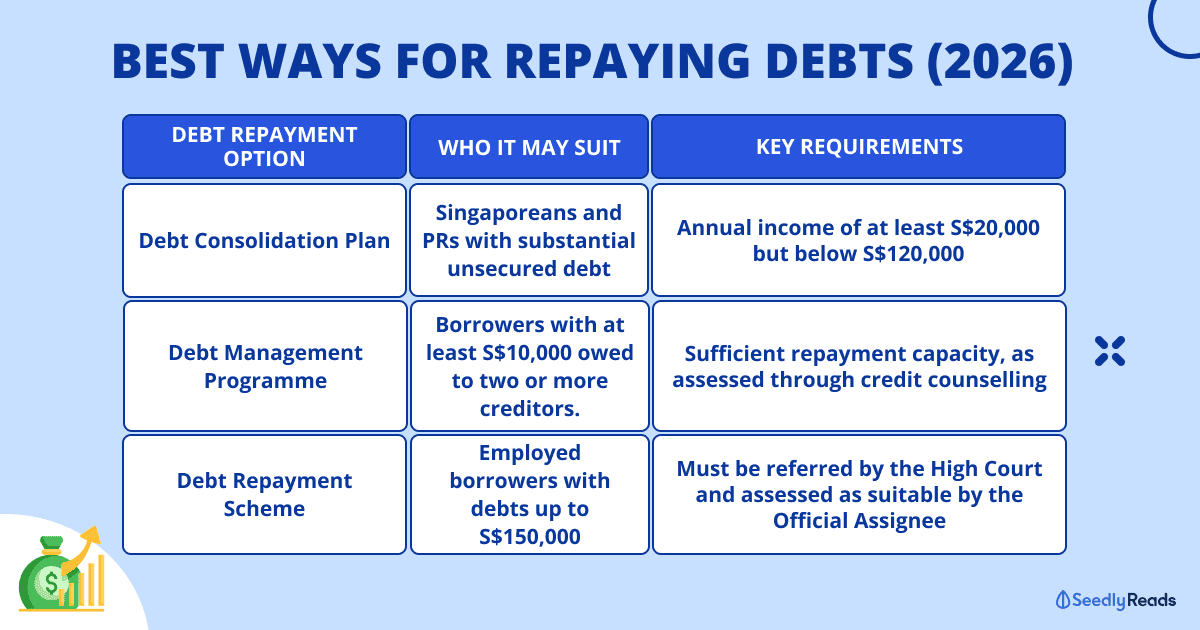
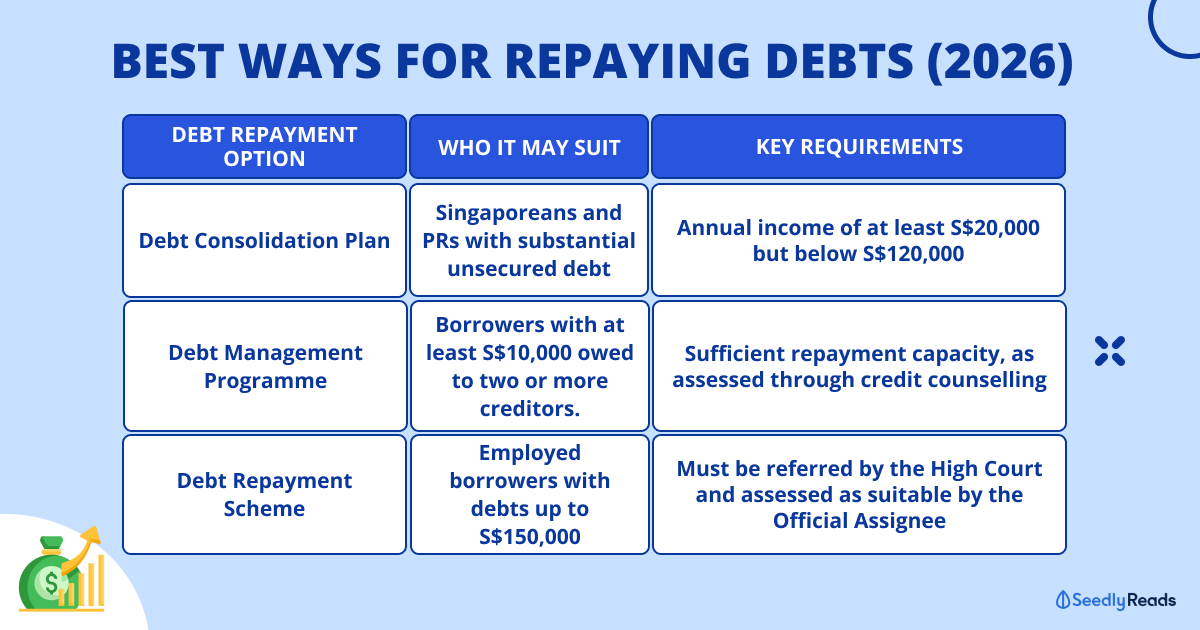
This is a summary of the pros and cons of the debt repayment methods:
Teleport here:
- Definition of good and bad debt
- Unsecured and secured loans
- What is debt repayment?
- Debt Consolidation Plan by financial institutions
- Court of Singapore ordered Debt Repayment Scheme
- Debt Management Programme by Credit Counselling Singapore
Disclaimer: The information provided by Seedly serves as an educational piece and is not intended to be personalised financial advice. Readers should always do their own due diligence and consider their financial goals before committing to any financial product and consult their financial advisor before making any decisions.
Good Debt vs Bad Debt

If you are just starting out your financial journey or your first time learning about debt, you may be surprised that not all debt is bad but how can you tell the difference between good debt and bad debt?
Good Debt
Basically, good debt is anything that increases your future value or net worth.
Debt such as taking out a mortgage or taking a loan for education is considered good debt, this is because although it may cost you money now, it will benefit you in the long run.
Bad Debt
Bad debt is the complete opposite of good debt, it is something that decreases in value after it has been bought.
Debts such as credit card and car loans will not increase your financial value in the future and your aim is to clear your bad debts first.
Fortunately for you, there are a few plans available out there to help when you find yourself in bad debt!
Unsecured Loans & Secured Loans

An Unsecured loan means that you are not required to put up any collateral (e.g., house, car) to borrow the money. It is definitely NOT about borrowing from unlicensed moneylenders such as loan sharks.
On the flip side, a secured loan is backed by something you own, and you can lose the asset if you default.
Regardless of whether the loan is an unsecured or secured loan, it is important to know the bank cannot hold you responsible for not repaying and writing off the debt as a loss.
This also means that the borrower is in default and there are severe consequences.
When you have defaulted on a loan, this affects your employment, access to money from your accounts, go through legal proceedings when initiated by the lender, and may potentially experience limited to no access to loans such as education, housing etc., due to poor credit record.
Some organisations require a yearly declaration of your financial status (at least it’s so in the Civil Service), so you’ll be required to declare your financial status.
Read more:
- Which To Choose: Credit Card vs Personal Loan
- Switching From HDB Loan to Bank Loan to Take Advantage of Low-Interest Rate? Here Are 5 Practical Things to Consider First
What is Debt Repayment?
Debt repayment refers to paying back the money you borrowed from a lender, including both the principal amount and interest.
Car loans, mortgages, student loans, and credit card debt are examples of common debts that many individuals must repay.
The failure to make timely payments on any debts can leave a trail of credit problems in its wake, including bankruptcy, higher late payment fees, and adverse lowering of your credit scores.
Is It Better To Pay Off Debt All at Once or Slowly?
It depends. Every loan has its repayment terms and conditions, with some imposing an early repayment penalty.
So, read the terms carefully before taking up one!
What Should I Pay First When Paying Off Debt?
Start with the most expensive loan first, i.e. the one with the highest interest rate.
This is because you can reduce the overall amount of interest you need to pay, hence decreasing your overall debt.
If you have trouble paying the full amount, pay it off in parts.
There are in fact, three ways to pay back loans and you should check them out below.
What Is a Credit Bureau Report?
Your credit report gives you and the lenders a snapshot or idea of your ability to repay credit.
In Singapore, the Credit Bureau (Singapore) CBS keeps credit reports for consumers in Singapore, and they partner with The Association of Banks in Singapore (ABS) and Infocredit Holdings Pte Ltd, which represent the majority of the retail banks and major financial institutions in Singapore to compile credit reports.
Your credit report matters as it affects your loan quantum and how much the financial institution is willing to lend you.

Debt Consolidation Plan Singapore
A Debt Consolidation Plan in Singapore, or DCP, allows you to combine qualifying unsecured credit facilities from different financial institutions into one debt consolidation loan with a participating financial institution.
As a result, instead of managing several payment dates and interest charges, you make payments under one consolidated facility.
However, a DCP does not cover every type of debt. Joint accounts, renovation loans, education loans, medical loans and credit facilities used for business purposes are excluded.
Who Is Eligible for a Debt Consolidation Plan?
To be eligible, you must:
- Be a Singapore Citizen or Permanent Resident
- Earn at least S$20,000 but below S$120,000 a year
- Have net personal assets of less than S$2 million
- Have total interest-bearing unsecured debt with financial institutions in Singapore exceeding 12 times your monthly income
Nevertheless, meeting these criteria does not guarantee approval. A DCP remains a commercial lending product, so each participating financial institution will assess your income, credit history and repayment ability.
In addition, interest rates, fees and loan tenures vary between providers. Therefore, compare the full repayment amount rather than looking only at the advertised interest rate.
Which Financial Institutions Participate in the DCP?
The Association of Banks in Singapore currently lists the following participating financial institutions:
- American Express International
- Bank of China Singapore
- CIMB Bank
- Citibank Singapore
- DBS Bank
- Diners Club Singapore
- GXS Bank
- HL Bank
- HSBC Bank Singapore
- Industrial and Commercial Bank of China
- MariBank
- Maybank Singapore
- OCBC Bank
- RHB Bank
- Standard Chartered Bank Singapore
- Trust Bank
- UOB
New institutions may be added or substituted over time. Consequently, check the latest ABS list before applying.
You only need to apply to one participating institution at a time. Still, it is worth reviewing the terms available from several providers before deciding.
What Happens After a DCP Is Approved?
Once the DCP is approved, the new financial institution will use the approved amount to pay down your qualifying unsecured debts with the other institutions.
Your existing unsecured credit facilities will generally be closed or suspended. However, the DCP usually includes a revolving credit facility capped at one times your monthly income for essential spending.
Meanwhile, you remain responsible for any shortfall if the approved DCP amount does not fully settle an outstanding account. Therefore, continue making your required payments while the application is pending and confirm that every balance has been settled after approval.
Debt Management Programme Singapore
A Debt Management Programme in Singapore, or DMP, is a formal consumer debt restructuring arrangement facilitated by Credit Counselling Singapore.
Unlike a DCP, the programme is not a new bank loan. Instead, CCS reviews your financial situation and may prepare a proposal for your creditors.
The proposal can cover unsecured personal debts such as:
- Credit cards
- Credit lines and overdrafts
- Personal loans
- Renovation loans
- Study loans
If you have sufficient repayment capacity, CCS may propose monthly instalments that allow you to repay your creditors in full over a reasonable period. Furthermore, the proposal may include reduced interest rates.
However, the lower rate is not guaranteed. Each creditor has sole discretion over whether to accept the DMP proposal and what terms it will offer.
Who May Qualify for the Debt Management Programme?
The general criteria are:
- You have at least S$10,000 in unsecured debt
- You owe unsecured debts to two or more creditors
- You have sufficient payment capacity to repay the debts fully within a reasonable time
First, you will need to provide information about your income, expenses, assets and outstanding debts. Next, a CCS credit counsellor will assess whether a DMP is suitable.
If the proposal is approved, you will make payments to each creditor according to the agreed repayment schedule. In addition, CCS provides onboarding and ongoing debt-servicing support.
Does a DMP Affect Your Credit Record?
Yes. While you are on a DMP, your existing credit cards and unsecured facilities will be cancelled.
Moreover, your DMP status will be reported to Credit Bureau Singapore. Consequently, financial institutions are unlikely to approve new loans or credit facilities while the status remains on your report.
Once you have fully settled all participating debts and informed CCS, CCS will report the completion to Credit Bureau Singapore. You can then gradually work on rebuilding your creditworthiness.
Therefore, a DMP is a serious commitment rather than a convenient way to reduce interest. Even so, it may offer a more structured route forward if you can repay your debts but cannot manage the existing payment terms.
Debt Repayment Scheme Singapore
The Debt Repayment Scheme in Singapore, or DRS, is a pre-bankruptcy arrangement administered by the Official Assignee.
Most importantly, you cannot directly sign up for the DRS. It is only considered after a bankruptcy application has been filed in the High Court by you or one of your creditors.
The Court may refer your case to the Official Assignee if your total liabilities do not exceed S$150,000. However, a referral does not mean that you will automatically enter the scheme.
Instead, the Official Assignee will assess your eligibility and suitability. If you are suitable, a DRS administrator will devise a formal Debt Repayment Plan.
Who Is Eligible for the Debt Repayment Scheme?
You must meet all of the following criteria:
- Your total liabilities do not exceed S$150,000
- You are gainfully employed and receive a regular income
- You have not been bankrupt or placed on the DRS within the previous five years
- You have not been subject to a court-based debt arrangement within the previous five years
- You are not a sole proprietor or partner in a firm
In addition, you must submit documents covering your financial affairs, income, expenses and proposed repayment plan.
Even after meeting the eligibility conditions, you must still be assessed as suitable. For example, the Official Assignee will consider your repayment capacity and whether your proposal provides an acceptable outcome for creditors.
How Long Does the Debt Repayment Scheme Last?
A Debt Repayment Plan may last for up to five years.
Once you are found suitable, you will need to make the approved first monthly instalment and pay the applicable statutory fee. The first annual fee is currently S$300.
After the first payments are made and the plan starts, the Official Assignee informs the Court and relevant parties. The bankruptcy application is then deemed withdrawn.
Furthermore, interest on admitted creditor claims stops running from the date the DRS begins. Nevertheless, you must continue complying with your monthly payments and all other conditions throughout the plan.
Once you complete the plan, you will be released from the debts admitted under the DRS. On the other hand, failing to comply may cause the arrangement to end and the bankruptcy proceedings to resume.
Debt Consolidation Plan vs Debt Management Programme
A Debt Consolidation Plan may be suitable when you meet the income and debt thresholds and can qualify for a new consolidation facility.
In contrast, a Debt Management Programme may be more relevant when you need CCS to help negotiate a formal repayment arrangement with several creditors.
There are also important differences:
| Feature | Debt Consolidation Plan | Debt Management Programme |
| Arrangement provided by | A participating financial institution | Credit Counselling Singapore, subject to creditor approval |
| New loan involved | Yes | No |
| Minimum unsecured debt | Must exceed 12 times monthly income | At least S$10,000 |
| Number of creditors | Not stated as a separate minimum | At least two |
| Citizenship requirement | Singapore Citizen or Permanent Resident | Assessed based on the programme’s criteria |
| Existing credit facilities | Closed or suspended after approval | Cancelled |
| Credit Bureau impact | Reflected through the borrower’s credit facilities and repayment record | DMP status is specifically reported to Credit Bureau Singapore |
| Interest rate | Set by the DCP provider | Reduced rates may be proposed, but creditors decide |
Therefore, do not choose based only on which option appears to offer the lowest interest rate. Instead, consider your eligibility, repayment capacity and the types of debt involved.
Debt Management Programme vs Debt Repayment Scheme
A Debt Management Programme is generally explored before bankruptcy proceedings begin. In contrast, the Debt Repayment Scheme only becomes relevant after a bankruptcy application has been filed.
Additionally, CCS facilitates the DMP, while the Official Assignee administers the DRS.
Under a DMP, creditors may voluntarily accept a repayment proposal. Under the DRS, however, the debtor enters a statutory pre-bankruptcy process after being referred by the High Court and assessed as suitable.
Therefore, the DRS should not be viewed as a normal debt-management product that you can apply for whenever repayments become difficult.
How to Get Out of Debt
Before entering any formal programme, take stock of your full financial position.
First, list every outstanding balance, minimum payment, due date and interest rate. Then, prioritise the debts carrying the highest interest charges.
For example, credit card balances usually cost more than secured housing loans. Therefore, paying down high-interest unsecured debt first can reduce the amount of interest that accumulates.
At the same time, stop adding new charges to your existing balances. Otherwise, your repayments may not reduce the debt meaningfully.
Next, prepare a realistic monthly budget. Cut non-essential spending, but leave enough for housing, food, transport, insurance and other necessary expenses. A repayment plan that leaves you unable to meet basic needs is unlikely to be sustainable.
Most importantly, contact your financial institution as early as possible if you cannot keep up with payments. The institution may be able to discuss repayment assistance based on your circumstances.
You can also approach Credit Counselling Singapore for independent debt counselling. However, avoid unregulated businesses that guarantee debt write-offs or ask for large upfront fees without clearly explaining the arrangement.
Which Method Would You Choose?
Be sure to always identify your good debts and your bad debts before approaching any financial institution.
When you have taken up a loan, you should draw up a budget, do a debt review and pay on time!
If you’re in doubt or have any questions, hop over to the Seedly Community and ask away!

Related Articles:
- Home Loans: Should You Lock In Current Rates Before They Rise Further
- Shorter vs Longer Home Loan Tenure: What Is Best For You?
- Protect Your Loved Ones From Home Loan Debt: Home Protection Scheme (HPS) Vs Private Mortgage Insurance vs Term Life Insurance
- Which To Choose: Credit Card vs Personal Loan
- How I Repaid My $28,000 Student Loan In Full After Graduation
Advertisement