
Embarking on a new hobby or learning a new skill always starts with joy and excitement, before you realise just how bad you actually are.

You’ll have absolute beginners like yourself, intermediates, experts, and legendary masters of their craft. But one thing that everyone, no matter how skilled they are, will have to go through is this:
Realising where you stand as that is the essential first step to future success.
And that’s exactly the same with personal finance!
Enter the wealth ladder, a framework that gives you an idea of where you stand financially. While you may find many different versions out there, here’s an in-depth explanation of the Singaporean wealth ladder, as well as tips on how you can move up to the next step!
TL;DR: The Singaporean Wealth Ladder
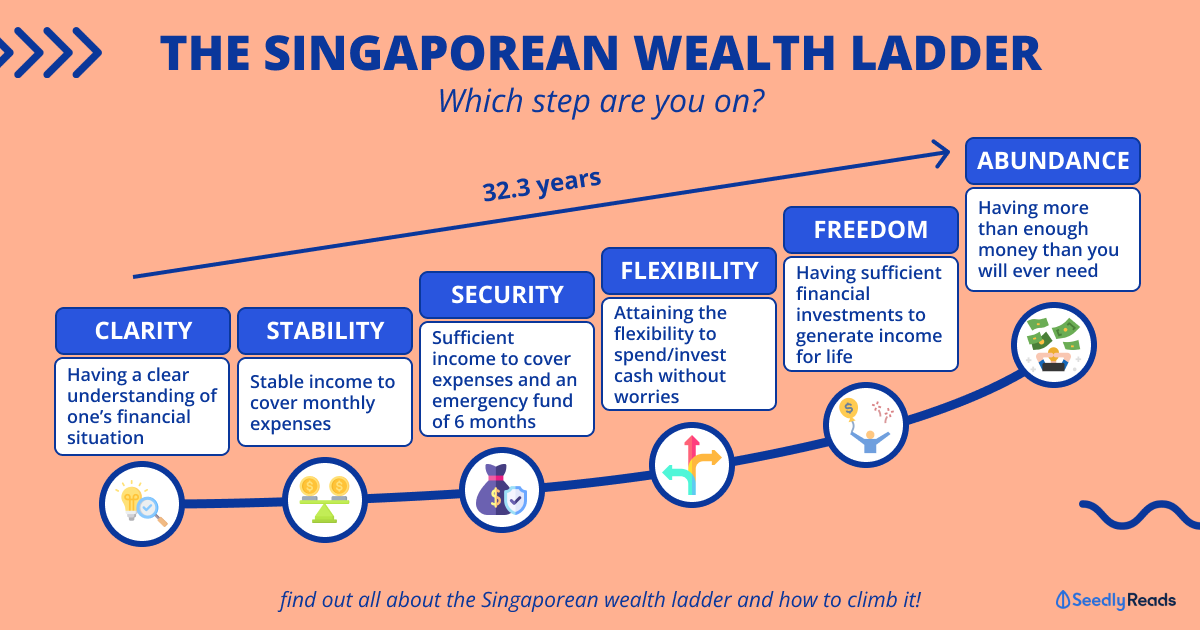
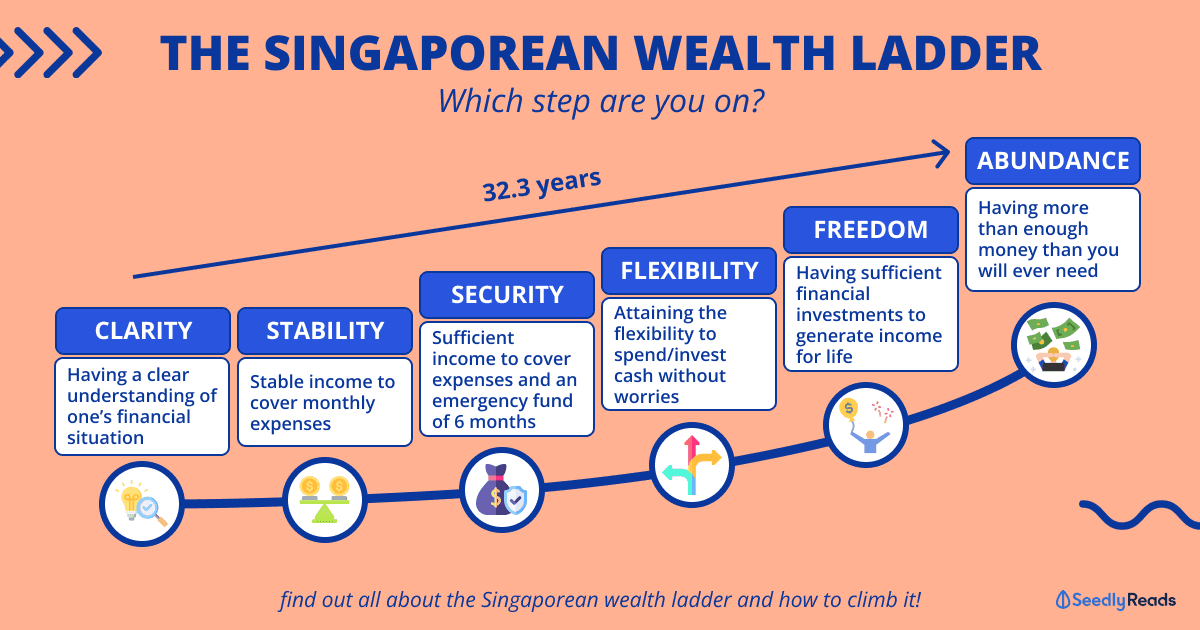
There are six steps to the Singaporean wealth ladder from financial clarity to financial abundance.
What Is Net Worth?
Before climbing the ladder, you need to know where you stand.
Your net worth is calculated as:
Total assets − total liabilities = net worth
Your assets may include:
- Cash and savings
- Investments
- CPF balances
- Property equity
- Business interests
- Other valuable financial assets
Meanwhile, your liabilities may include:
- Housing loans
- Education loans
- Car loans
- Personal loans
- Credit-card balances
- Other outstanding debts
For example, suppose you have S$180,000 in cash, investments and CPF savings, together with S$300,000 of home equity. If you owe S$250,000 across your housing and other loans, your estimated net worth would be S$230,000.
Nevertheless, net worth alone does not show whether you can manage an emergency or pay your bills comfortably. A large share of your wealth could be tied up in your home, while your liquid savings remain low.
Is There an Ideal Net Worth by Age in Singapore?
Many readers search for net worth by age in Singapore or ask what net worth is considered wealthy by age.
There is no official Singapore benchmark that tells you exactly how much net worth you should have at 25, 30, 40 or 50. Furthermore, a simple target may overlook major differences in each person’s circumstances.
For example, someone who owns a home may have a higher net worth but a large mortgage. In contrast, another person may rent while holding more liquid investments. Someone supporting children and elderly parents will also have different financial needs from a single person living with family.
Therefore, instead of chasing a universal age-based number, compare your progress against your own goals:
- Are your high-interest debts under control?
- Can you cover an emergency?
- Are you saving and investing consistently?
- Are you adequately insured?
- Are you on track for major goals and retirement?
With that foundation in mind, here are the six stages of the Singaporean wealth ladder.
Step 1: Financial Clarity
Financial clarity means knowing exactly what is happening with your money.
At this stage, you should know:
- How much you earn each month
- Where your money goes
- What assets you own
- How much debt you owe
- Which financial goals you are working towards
Start by listing your assets and liabilities. Next, review at least three months of transactions so that you can identify recurring expenses and spending leaks.
After that, create a realistic budget. Your budget should not be so restrictive that you abandon it after two weeks. Instead, it should help you cover essential expenses, repay debt and set aside money for the future.
Most importantly, do not ignore overdue balances or repayment difficulties. The earlier you speak to your lender, the more options you may have.
What if you are struggling with debt?
Singapore has several forms of debt support, but they serve different situations.
The Debt Management Programme facilitated by Credit Counselling Singapore generally considers borrowers who:
- Have at least S$10,000 in unsecured debt
- Owe money to at least two creditors
- Have enough payment capacity to repay their unsecured debts fully within a reasonable period
Meanwhile, the Debt Repayment Scheme in Singapore is a pre-bankruptcy arrangement administered by the Ministry of Law’s Official Assignee.
You cannot apply for the Debt Repayment Scheme directly. Instead, a bankruptcy application must first be filed in the High Court. If your debts do not exceed S$150,000, the court may refer your case to the Official Assignee for assessment. If accepted, you may follow a repayment plan lasting no more than five years.
Therefore, contact your lenders or Credit Counselling Singapore early instead of waiting until legal action begins.
Step 2: Financial Stability
You reach financial stability when you can pay your monthly expenses and still save part of your income.
This does not mean you need a high salary. Rather, your regular income must be sufficient for your present lifestyle without continuously relying on credit.
At this stage, focus on building an emergency fund. MoneySense recommends setting aside at least three to six months of expenses.
For example, if your essential monthly expenses total S$2,500, you could work towards an emergency fund of S$7,500 to S$15,000.
However, your target may need to be higher when:
- Your income fluctuates
- You are self-employed
- You support dependants
- You have significant medical or housing commitments
- It may take longer to find another job in your industry
Keep this money somewhere accessible and relatively stable. After all, an emergency fund is intended to handle unexpected expenses—not to maximise investment returns.
Step 3: Financial Security
The study defines financial security as having sufficient money after monthly expenses to save and invest.
In other words, you have moved beyond simply building a cash buffer. You can now direct money towards longer-term goals such as retirement, education or home ownership.
Before investing, however, make sure your short-term finances are sound. High-interest debt can grow faster than many investments, while investing money needed in the near future may expose you to unnecessary losses.
MoneySense’s Basic Financial Planning Guide provides several broad rules of thumb:
- Maintain an emergency fund of at least three to six months of expenses
- Invest at least 10% of your income for retirement and other goals, where suitable
- Spend no more than 15% of your income on insurance protection
- Consider death and total and permanent disability coverage of about nine times annual income
- Consider critical-illness coverage of about four times annual income
These are starting points rather than compulsory targets. Therefore, adjust them according to your dependants, existing CPF coverage, employer benefits and financial obligations.
Step 4: Financial Flexibility
Financial flexibility means having enough investments or assets to cover your living expenses for up to one year.
Suppose your essential living costs amount to S$36,000 annually. At this stage, you would have sufficient accessible financial resources to support yourself for up to a year without employment income.
As a result, you may have more freedom to:
- Take a career break
- Change industries
- Start a business
- Care for a family member
- Manage a prolonged loss of income
- Move to a less stressful but lower-paying role
However, not every asset is equally accessible. Your home may contribute significantly to your net worth, but you cannot necessarily use it to pay next month’s bills without selling, borrowing against it or renting part of it out.
Therefore, consider both your total net worth and your liquid assets when measuring flexibility.
Step 5: Financial Freedom
Financial freedom means your investments or assets can generate sufficient passive income to support your lifestyle on an ongoing basis.
However, “passive” income is rarely completely passive. Rental properties require maintenance, dividend payments may change and investment values can fall.
Consequently, your financial-freedom target should include a margin for:
- Inflation
- Healthcare expenses
- Market downturns
- Taxes and fees
- Home repairs
- Changes in family responsibilities
- A longer-than-expected retirement
Moreover, financial freedom does not require an extravagant lifestyle. If your annual expenses are lower, the portfolio required to support them may also be lower.
Therefore, control over spending can be just as important as investment returns.
Step 6: Financial Abundance
Financial abundance is the highest stage in the source framework.
At this level, you are financially stable and have more income or wealth than you are likely to require during your lifetime. Consequently, your priorities may move beyond personal financial security towards:
- Supporting family members
- Charitable giving
- Estate planning
- Business succession
- Intergenerational wealth transfer
- Preserving wealth for future generations
The study also found that respondents at the abundance level tended to accept more investment risk. Specifically, 34% described their approach as high-risk, compared with 21% of respondents at the stability level.
Nevertheless, this does not mean taking more risk automatically makes you wealthy. Your investment strategy should still match your goals, ability to absorb losses and investment horizon.
What Net Worth Is Considered Wealthy in Singapore?
There is no single official net-worth threshold that makes someone “wealthy” in Singapore.
Similarly, a definitive top 1% net worth figure is difficult to establish because reports may measure wealth differently. Some count property and pension assets, while others focus on investable assets. Certain reports also measure households, whereas others assess individuals.
Therefore, a person can have a high net worth on paper but limited cash flow. Conversely, someone with a smaller net worth may have low expenses, no debt and enough recurring income to enjoy substantial financial freedom.
A more practical definition of wealth is whether you have enough resources to meet your needs, withstand setbacks and make meaningful choices without constant financial pressure.
How Long Does It Take to Climb the Wealth Ladder?
The 2023 St. James’s Place study reported the following average progression times:
| Progression | Average time |
| Financial stability to financial security | 6.1 years |
| Financial security to financial flexibility | 6.5 years |
| Financial flexibility to financial freedom | 8.7 years |
| Financial freedom to financial abundance | 11 years |
| Total | 32.3 years |
Additionally, 42% of surveyed investors said they were not as wealthy as they wanted to be.
Still, your own journey may be much shorter or longer. Your income, spending, family background, housing situation, health, investment returns and financial responsibilities will all affect your progress.
Therefore, use the ladder as a guide—not as a competition.
Closing Thoughts
Your level of wealth should not be measured only by your salary or by whether your net worth is higher than that of someone your age.
Instead, ask what your money allows you to do.
Can you meet your monthly commitments? Can you handle an emergency? Are you building assets for the future? Most importantly, are you gaining more control over your time and decisions?
You may not reach the next step immediately. Nevertheless, each debt repaid, dollar saved and sensible investment can move you closer to it.
Advertisement